You are a River, Not a Stone
Why Seeing Yourself as a Process Is Real Hope
There is a question I like to ask in our residential healing retreat spaces: who were you, three years ago, when you got impatient or depressed?
Not what happened — who reacted. What did that flare of irritation seem to be protecting? What did your body do with it? If you're honest, the "you" who used to snap at criticism, or freeze at conflict, or need to be right, is not fully the "you" sitting here now. Something has already shifted. And something will keep shifting, whether or not you notice it.
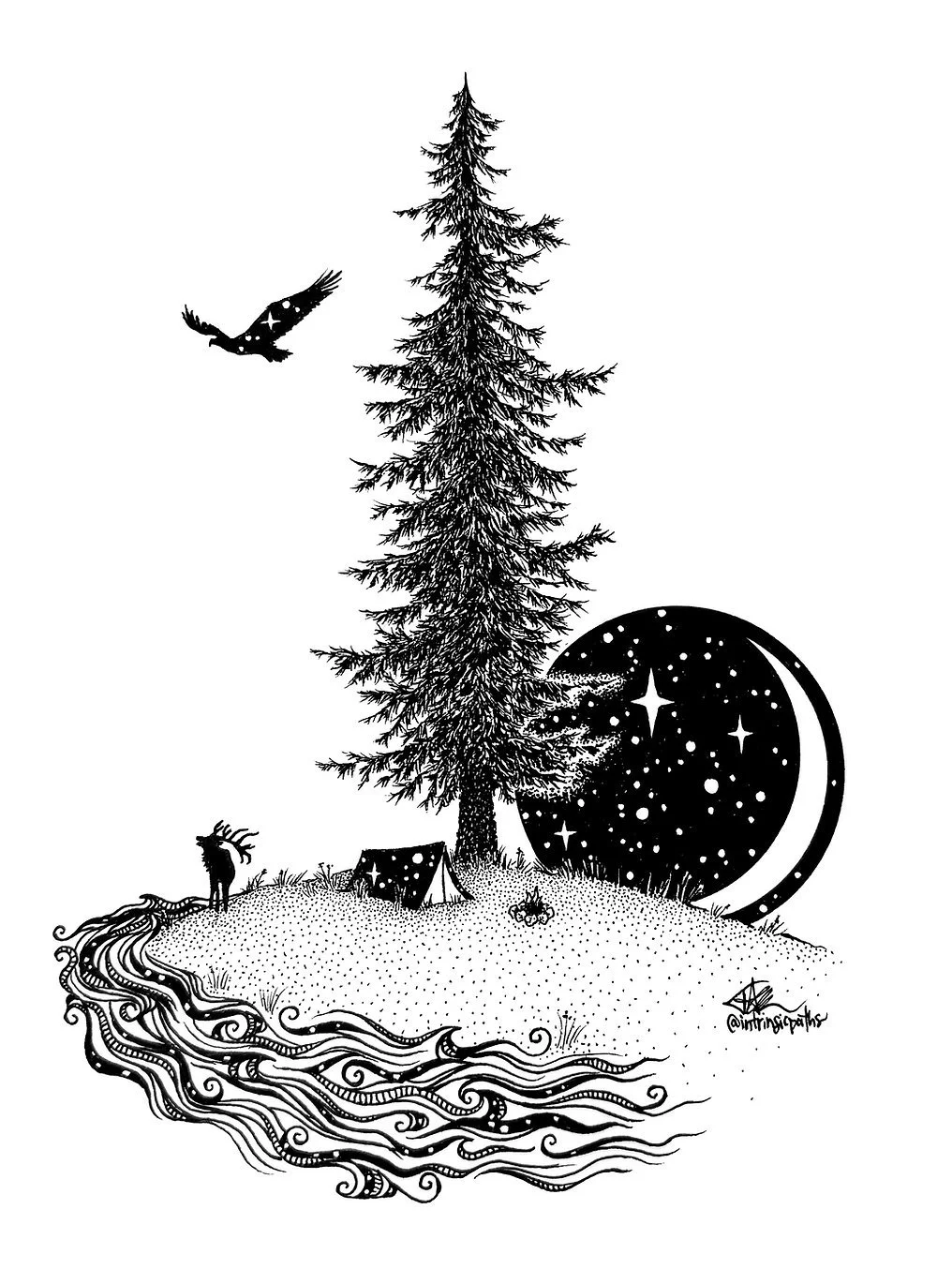
This is the invitation of this piece: to stop relating to yourself as a fixed permanent isolated stone, and start relating to yourself as a flowing changing and ever-renewing river.
The Body You Think Is "You" Is Already Dying and Being Reborn
Let is start with the body, because it's the easiest place to see this clearly.
We tend to walk around assuming our bodies are stable objects — the same skin, the same hands, the same heart we've always had. But biologically, this isn't true at all. On average, the cells in the human body are replaced every seven to ten years, though this hides enormous variation across different organs.
Consider the range: neutrophils, a type of white blood cell, may last only two days, while the cells at the center of your eye lenses may last close to your entire life. In between sits almost everything else that makes up "you" — heart muscle cells survive for about forty years, some intestinal cells or skeletal muscle 15-16 years, fat cells about eight years, and liver cells turning over in ten to sixteen months, with pancreas cells renewing roughly annually.
Sit with that for a moment. The liver cell doing its quiet work right now did not exist a year and a half ago. Much of your gut, your body fat, your muscle has already turned over more times than you can count since childhood. There is no single physical object, no fixed thing, that has been "you" all along. There is only a continuous, self-renewing process — arising, dissolving, arising again — that we've agreed to call by one name.
Modern biology, in other words, is quietly confirming something contemplative traditions have taught for millennia.
Anattā: The River
In Buddhism, this insight has a name: anattā (non-self), sometimes explored through the word śhūnyatā (emptiness). See my definitions of non-self and emptiness here. The teaching is not that you don't exist. It's that there is no fixed, permanent, independent "you" residing somewhere inside the body — no unchanging owner, controller, schemer/planner behind the eyes, no essential core that stays the same while circumstances swirl around it.
Let us consider a water body. Every river or sea can be given a name — e.g., the Ganges or the Nile — and a recognizable course, banks, a rhythm. But not one molecule of water in that river today was there a hundred years ago, or even a season ago. The river is real. It is also entirely process. It is what it does, not what it's made of. It flows.
We humans are the same. What you call "yourself" is a pattern in motion — a flow of sensations, thoughts, roles, relationships, and yes, literal cells — that has enough continuity to be recognizable and not enough permanence to be a fixed entity.
We change. That is not a Flaw — It's the whole point
This is why I invite people, especially in the context of spiritual practice not to judge themselves by their past or even current reactivity.
The version of you that got impatient with your mother two years or two days ago, defended by a particular story about who you had to be, was working with a different nervous system, different griefs, different unprocessed material. Your sense of your own ego — what you were touchy about, proud of, ashamed of, quick to defend — has already moved. How you define yourself, and what you react to, is not the same as it was even a few hours ago.
At the level of what I call the Buddhayāna view — the widest, most accepting lens in the study of precepts and paramitas — the invitation is to stop grading yourself on your level of patience, generosity, beauty, or intelligence. Not because those qualities don't matter, but because fixing a grade onto a process is what causes so much of our suffering. And this isn't only self-directed: if there is no permanent "you," there is also no permanent, essential "them." This is “clear seeing” or part of seeing reality “as it is”. The same non-judgment and loving witnessing we're learning to offer ourselves is owed to others.
The difference between judgment and discernment
I want to be careful here, because this teaching gets misunderstood as an invitation to stop noticing anything — to collapse into a vague, boundary-less "everything is fine." That's not it. Our community wants to confront polycrisis and systems of oppression: we are not here to bypass anything.
Discernment is simply seeing clearly: is this three, or is this five? Is this red, or is this blue? Is this a cat or a leopard? Discernment lets us notice where someone — including ourselves — actually is right now, without attaching a verdict/grade to it.
Judgment is what happens when we take that same observation and stamp it good or bad, worthy or unworthy. Judgment freezes a moving process into a fixed identity: not "I reacted with impatience just now," but "I am an impatient person." Not "this person is currently causing harm," but "this person is evil."
We absolutely need discernment — to see clearly is an act of compassion and wisdom, even an act of protection. What we're being invited to release is the second move: the labeling that turns a snapshot of a river into a permanent stone.
So the practice becomes this: know yourself as a process, and meet wherever that process currently is with loving-kindness and equanimity. Not resignation. Not passivity. Just an accurate, tender way of seeing.
Why this is the actual hope in Buddhism
Here is the part I most want to land: this teaching isn't just a nice metaphor for self-compassion. It's the spiritual root of hope itself.
If human beings or even our “souls” or “energy bodies” were fixed entities, then good and evil would have to be fixed entities too — permanent, essential categories baked into certain people forever. Buddhism does not support that view. There is no permanent, independent, unchanging "evil" or “goodness” sitting inside anyone, any more than there's a permanent, unchanging "you." Buddhism doesn’t have notions of “evil” or “sin”. Buddhism has what is called “delusion” or confusion. There are causes and conditions. There are patterns, deeply grooved by trauma and circumstance, that produce harmful action — and patterns, because they are processes and not essences, can shift.
This is exactly why Buddhism offers such solid spiritual roots for a healing justice framework.
For me, healing justice rests on two convictions:
First, we must address the layers of trauma in a community, because traumatized people traumatize others. Layers of harm that are never composted, never grieved inside a loving community, don't disappear — they get perpetuated, passed down, re-enacted. This is precisely why healing justice shifts the burden of well-being away from individualized self-care or one-on-one therapy alone, and toward community-supported healing: ceremony, mutual aid networks, collective grief and rage work.
A river doesn't heal in isolation; it needs a whole watershed.
Second, healing justice trusts that most human beings have the capacity to change. This is not naive optimism — it's a claim that non-dual and animist traditions across cultures and bioregions independently affirm, from Buddhist teachings on anattā to Indigenous frameworks that understand personhood as relational and evolving rather than fixed. If people are processes rather than stones, then change is not the exception. It's the nature of things.
The real hope
When we begin, lovingly, to view ourselves as processes — as rivers instead of stones — something loosens. We stop needing to defend a fixed self-image. We stop needing to permanently indict the people who have harmed us, or permanently indict ourselves for the ways we might have caused harm.
This is not a tragedy. Impermanence is not a loss to grieve at every turn — it is also the very thing that makes healing, justice, and transformation possible at all.
You are not the stone you were afraid you'd always be. You were never a stone to begin with. You are a river — cell by cell, breath by breath, still flowing, still becoming. That is not a threat to who you are.
Notice your patterns. Lovingly. That is the hope.