More reflections on Patience
Before you begin to read and digest this short piece of writing, please tell your body, in whatever way works for you: "Hey body, I'm going to be kind to you as I examine my own patterns around patience, impatience and freezing."
Importance of working on Patience:
It's not a coincidence that the study of precepts and pāramitās starts with patience. Working on patience is a lifelong practice — in fact, I feel like the entire precept and pāramitā practice can fold into this one practice. And it's hard to do this “patience” practice meaningfully without some kind of silent, meditative practice, because this paramita invites us to know: what does patience look like in my body? We can't notice our patterns well if we're busy — if we haven't slowed down enough to catch a hard reaction, like impatience or freezing, before it fully blossoms.
The lake metaphor: Imagine a calm lake surface. None of us reach a perfectly still lake-like mind-state, but let's say we get close. A ripple of impatience or freezing arises — can we catch it in its budding stage, before it becomes a fully formed wave? That is what I’m asking us to do nefore our next class, again and again.
Summary of four views on patience
Theravada (Early) view — quite literal: were you patient, or were you impatient? This view can miss the nuances. It can feel judgemental and punishing.
Mahāyāna view — I tend to see this as a trauma-informed lens. Whatever you feel impatience or freezing around, what were the causes and conditions that led to it? At least theoretically, we can say: this situation I feel impatient around is the result of lifetimes of trauma passed from person to person, community to community, nation to nation. My ripple of impatience isn't going to fix generational trauma — so it invites patience by viewing things from perspective of “compassion” (as well as “wisdom” of knowing that everything has a potential to change. See below).
Buddhayāna view — This lens is one of the two most important to me. It asks us to accept everything: death, suffering, impatience, patience, freezing. Nothing is wrong. It doesn't say impatience is wrong, or patience is right — it's radically accepting. If you've meditated for a long time or done long retreats, sooner or later you touch a place of genuine equanimity no matter what is unfolding. This view says — everything is not just "okay" — it can be experienced as a “sweet natural wholeness”.
Polycrisis view — is the other most important one for me. This view names that we live under systems of oppression, that trauma is being actively perpetuated and we must do everything we can to stop the cycles of oppression. Paradoxically, experiencing the Buddhayāna truth of acceptance in our own body (not intellectual understanding) is what creates the spaciousness to act on the systemic polycrisis level: when you see harm happening, say a sacred no. Be a little wisely impatient. Organize. Don't sit in superficial acceptance — wake up. Buddhayāna-level acceptance creates the spaciousness to act with wise resolve.
Example: I got COVID very early on in 2020 and was on oxygen for two weeks. It was scary. A Buddhist magazine invited me to write about facing the fear of death, and what I wrote applies to everything we do in practice: we have to hold the paradox of accepting that death and suffering will come to all of us, and work with — and accept — that fear of death and suffering, in order to be able to work on reducing death and suffering.
Patience can be seen as an acquired skill, and when our nervous systems are dysregulated because of pain, exhaustion, sense of being unsafe etc, we lose access to “patience”. And yet, from the Buddhayāna perspective, in the ultimate sense patience isn't only a skill — it's a state of mind beyond fight, flight, freeze, and fawn; a spacious, accepting mind that's possible even amid exhaustion.
Are you mostly impatient with yourself or others?
Spiritual practice, in essence, is a practice of sacred and compassionate listening — we could call it sacred attunement to our own bodies and hearts. For some people, it is easy to be compassionate to others but not themselves. Others find it easier to be kind to themselves but not others. Genuine patience opens up complexity and creativity instead of narrowing into right/wrong because we're more capable of sacred listening and attunement, more welcoming of complexity instead of judgment.
People who are impatient with themselves may need more mettā practice for their inner child. People impatient with others may be projecting outward what feels wrong in the world. In the "four layers of belonging" framework, the first layer is belonging to your own self — so the first group may have work to do with their inner child, inner teenager, inner baby. The second group might still need self-compassion, but could also look at the Mahāyāna question when impatient with others: how did they get to where they are? That doesn't mean not acting — if someone is oppressing another person, a sacred no is still needed — but it shapes the mental attitude brought to the act of saying no.
Healthy patience
As we differentiated between healthy patience and unhealthy patience (freezing/numbing or passive aggressive silence), joy isn't one thing either. There's a difference between equanimous, grounded joy versus giddy joy, just as there's egotistical anger versus sacred wrath (the wrath of Kali). Part of our journey is learning to notice these different shades, the way we learn to distinguish between different shades of red or blue.
We must differentiate between patience and spiritual bypassing which has been used — in our own families and communities — to say "just accept." Whiteness enforces unhealthy or false patience on us because whiteness asks us to be okay with atrocity. Finding wise impatience, or wise rage, is part of the work of unpacking internalized white supremacy. Patience doesn't mean we don't make time to express emotions — patience is not damming of emotions. I hope you all have spaces for rituals and ceremonies of grief and sacred rage.
Who Is feeling patience or impatience?
One of the most important prompts when working with the paramita of patience is this: Who — which voice or identity — feels patience, impatience, or numbing?
We internalize the voices of our critical parents or bosses — or even a kind of superego imposed by religious or spiritual traditions ("you must be patient, you must be virtuous, you must be kind"). And what's fascinating is that in real patience, all the good and bad internalized voices go quiet.
Before impatience arises, watch for the internalized voice defining "who" is impatient — e.g., I'm mad at this because I'm anti-racist, or I'm mad at this because I'm queer/trans. Notice how a moment of impatience is tied to how we define ourselves — our definition of "I."
Please deeply reflect on what is the sense of “I”, “me”, my “definition of myself” or my “identity” that arises right before impatience fully arises in you. There is no right and wrong answer here. All that is being asked of us is to be aware of how you are defining yourself: what is your ego composed of. Sometimes we love being impatient because impatience is associated with our “righteous anger”. We don’t want injustice in our personal or political lives. So impatience is not “wrong”. The ask is this: can we be aware of the root of our patience or impatience.
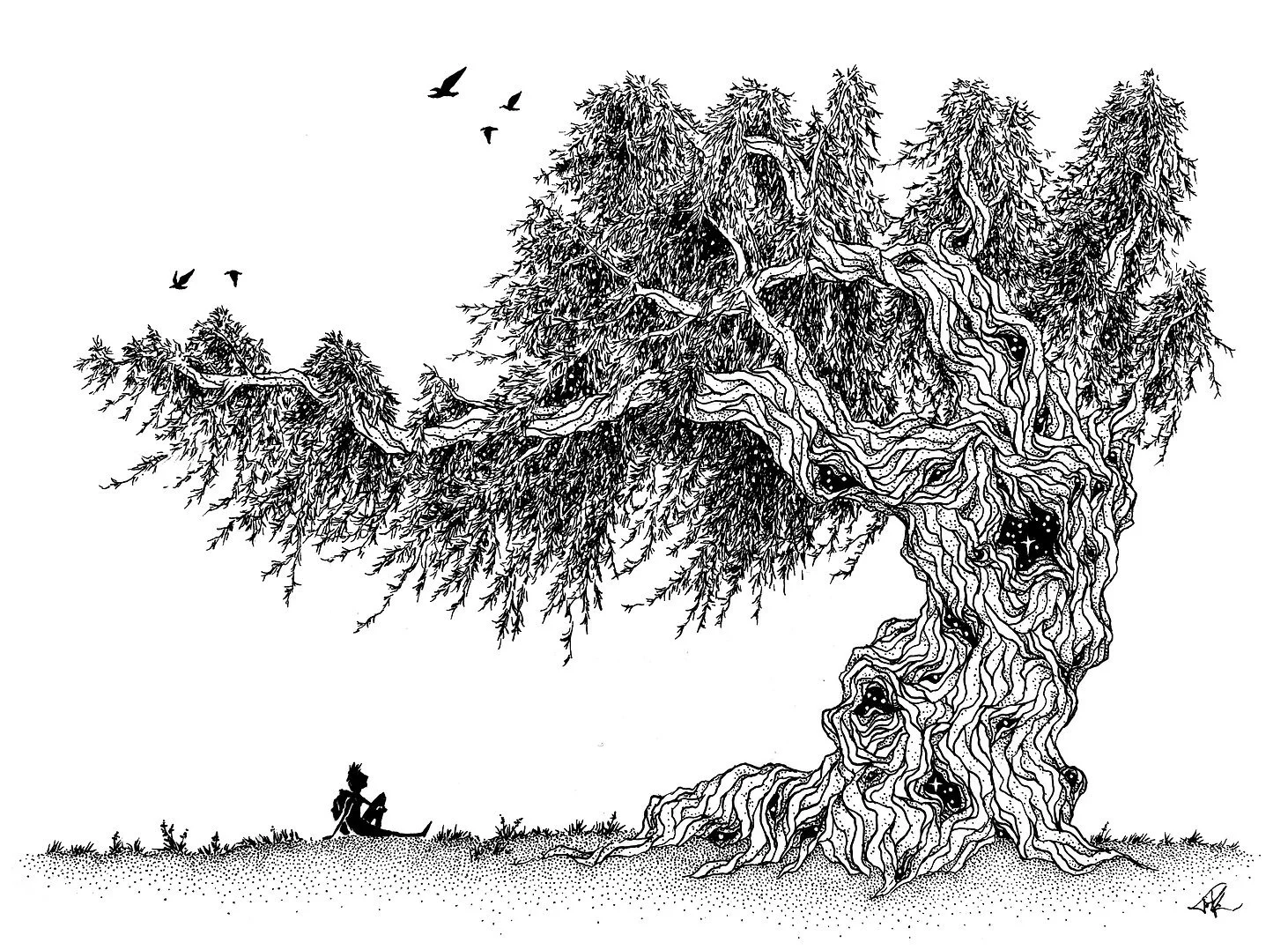
I can be pained by what is happening, and also rooted in a sweet equanimity that doesn't suppress grief-rage but fully allows them. Like a flexible willow: rooted deeply in the earth even while losing limbs to turbulent storms, falling apart, and accepting life while not giving up on life. Offering resistance without rigidity, without numbing, without losing my essence.