My Spiritual Roots
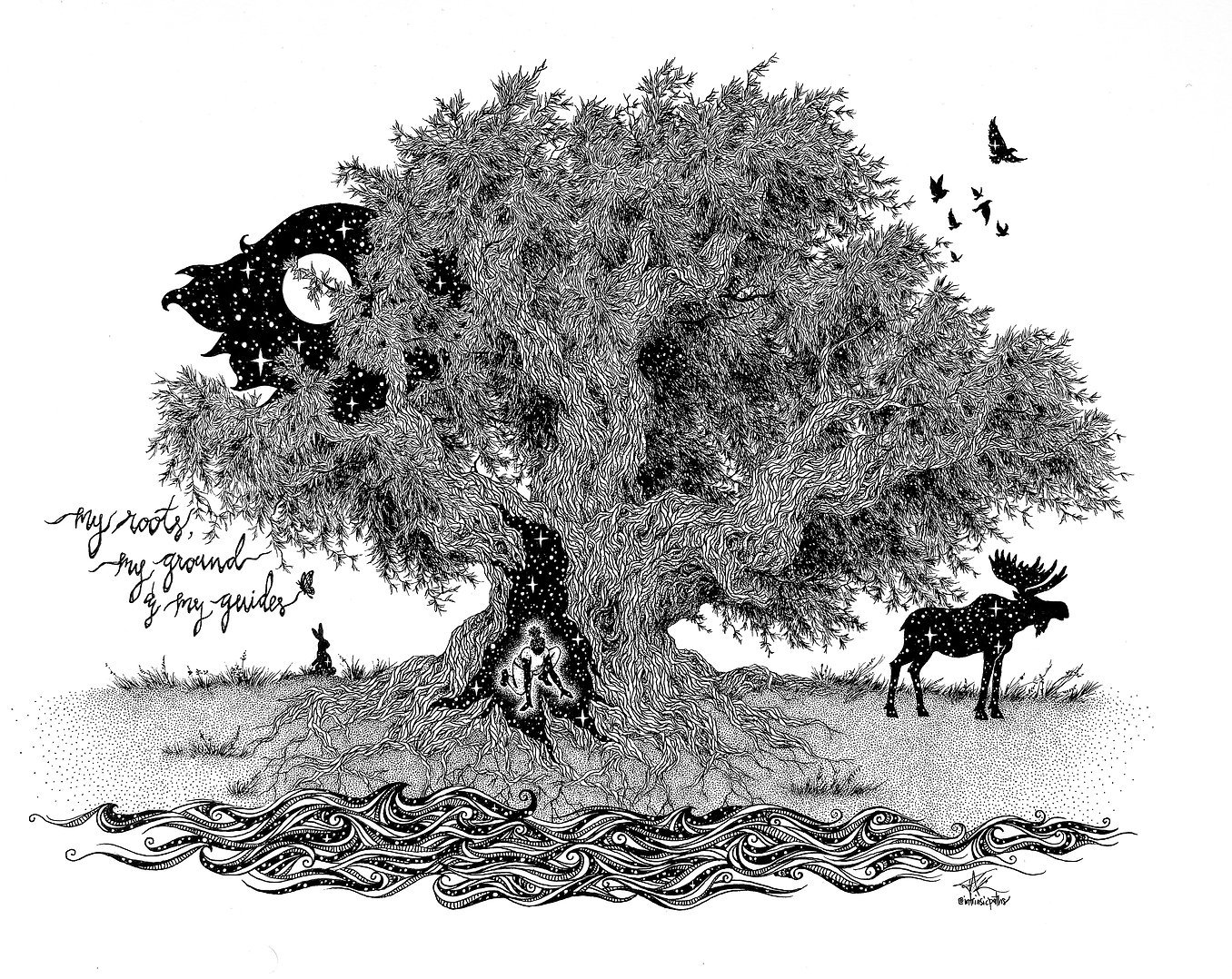
1. Root lineage - Zen: Silent Discipline, Compassion, and its shadows
I have done over eighty 5-10 day long completely silent meditation retreats since 2002.
My formal Buddhist priest ordination is in Cold Mountain Zen — a Rinzai Zen lineage that traces itself to Han Shan, a 9th century Chinese poet-monk who walked away from the monastery into the mountains, wrote poems on rocks and trees, and was too strange for respectable Buddhism and too Buddhist for the literary world.
Zen gave me rigorous access to simplicity, compassion and inner vastness. The early morning sits, the precise attention to posture and breath, the long silent retreats (sesshins), the encounters with a teacher that require us to show up retreat after retreat, year after year— not conceptually, but actually. This is direct investigation of our own experience, not as a belief system, but as something we test. The tradition doesn't let us rest on spiritual accomplishment.
Zen is also a Mahayana tradition, which means it is animated by a grand aspiration: not just individual liberation, but the liberation of all beings. The Bodhisattva vow — “However innumerable the beings, I vow to free them all” — is not a preamble to practice. It is the whole orientation of it. This is why Zen, for me, has never been separable from justice work.
And then there is what Zen points toward beyond any category: moments in deep practice where the boundary between self and other, sacred and ordinary, simply isn't there. The tradition calls this by many names — Mu, Suchness, Original Face. What it feels like from inside is more like a surprise: the world is more intimate, more whole, more complete than the thinking mind ever allowed, even in this world of polycrisis. When I hear Indigenous elders say that the land is alive and that we are in relationship with it, not above it — I recognize it because of years of Zen practice.
Shadows of Rinzai Zen: As practiced in the West, the lineage has deep blindspots and shadows around trauma. The tradition was designed for male monastics in a different century, not for people carrying layers of ancestral, racial and personal trauma who then sit down for seven days of silence few times a year. I have seen real harm happen in Zen containers that didn't know how to hold the nervous system dimensions of what gets stirred up at retreats. Zen teachers, like charismatic Tibetan gurus, have also transmitted a lot of trauma when they haven’t cared for their own nervous systems.
2. Ecodharma and nature practices
Ecodharma is the recognition that spiritual practice and ecological/political belonging are not separate things. The Buddha sat under a tree. He woke up in a forest. The early monks and nuns practiced in the wilderness. The wild world has always been part of this path — it just got edited out when Buddhism moved indoors.
The love for practicing in wild nature that my Zen lineage ancestor Han Shan must have embodied was genuinely not available to me for most of her life. I grew up without access to wild spaces, and my body's chronic illness made wandering in the natural world feel impossible. That part of my Zen lineage came alive only after I co-founded Rocky Mountain Ecodharma Retreat Center in Colorado and finally had a mountain to call home.
For me, Ecodharma is the branch of Buddhism that most directly answers the ecological crisis not just as a policy problem but as a symptom of separation or a crisis of belonging. We are destroying the living world because we have forgotten that we are part of it. The antidote is not primarily more information. It is direct experience: sitting with a watershed long enough to feel something. Grieving for a species that has disappeared. Letting a forest actually speak to us.
I came to this slowly, through the limits of my own body and poverty I grew up in. The natural world is now a genuine teacher for me. When a thunderstorm interrupts a retreat, I consider that part of the teaching.
3. Tantric Buddhist lineage: Emotions as doorways to Invisible realms
This is perhaps the most unusual of my lineages, and also the one that has most changed how I work.
One of my teachers, Anuttara Lakshmin Nath, introduced me to a branch of Tantric Buddhism that is, at its heart, the most animist form of Buddhism I know. In this view, everything is alive, everything is energy, and every emotion — including the ones we most want to avoid — is a doorway, not an obstacle.
What the tradition calls "deities" are not supernatural beings floating in a sky somewhere. They are the coherent energy fields that become available when we have done enough inner work — enough composting of grief, enough compassionate witnessing of rage past the point where you want to flee — that your ordinary perception begins to open into something beyond viisble measurable realms. People who have done this work often describe sensing energy fields that feel distinct from ordinary body sensation: a quality of warmth, intelligence, or presence that isn't coming from them, exactly, but that they are in contact with. Entering a cathedral, or a forest, or a grief ceremony held with great care — you can sometimes feel the difference between a space that is alive and supportive and a space that is depleting. That difference is real.
The most important teaching I received in this lineage, from Joanna Macy and my beloved teacher Beth Garrigus is this: the path to the more beautiful, more conscious states of being runs directly through the emotions we most want to avoid. Grief, anger, and fear are not spiritual problems. They are gatekeepers. When you are willing to go all the way into them — with support, in community, in the body — something transforms. This is the composting at the heart of grief and rage ceremony work.
4. Animist Buddhism of Asia and Reindigenizing the Dharma
What I want to name next is not quite a separate lineage but more like a recovering of what was always there. When Buddhism traveled from Asia to America, a lot got left behind: the spirit communication, the ancestor rituals, the relationship with local deities and natural forces, the understanding that rivers and mountains are alive and have something to say to us.
This wasn't accidental. The parts of Buddhism that looked "primitive" to Western eyes were the parts most continuous with Indigenous wisdom — and so they were filtered out in favor of what was rational, measurable, and safe for modernity. What got lost was exactly what we most need right now: a felt sense of belonging to the living world, not just an idea of it.
Reindigenizing is the frame I use for this work. It means reconnecting with the hurting parts of our own bodies. Building genuine relationship with people who have been "othered." Belonging to a local ecosystem, a watershed, a specific piece of land. And taking seriously the intelligence of what the traditions call the invisible realms — ancestors, spirits, the more-than-human community that we are always, already, inside.
This is the most ancient form of Buddhism. It predates everything that got systematized. And it is alive, still, in Tibetan practice, in Japanese forest traditions, in Southeast Asian folk Buddhism. It is the Buddhism Han Shan was living on his mountain. It is what Joanna Macy did when she was on the floor sobbing for the world's waters. It is what happens in our grief ceremonies when something moves through the room that no one quite planned.
5. Nonviolence as a spiritual practice
Before I ever heard the word "Buddhism," there was ahimsa — non-harm — in my Jain household. There was my grandfather, the "Gandhi of Haryana," absorbing insults rather than returning them, choosing his own suffering over shaming others. There was an understanding, absorbed very young, that love for your opponent is not weakness. It is the most demanding spiritual practice there is.
This is what Gandhi called Satyagraha — the force of truth. What Martin Luther King called "Agape love" — love not as sentiment but as a fierce commitment to the humanity of the person who is trying to dehumanize you.
Buddhism has its own version of this: the Bodhisattva who keeps turning toward all beings, including those who cause harm, because the causes and conditions behind harmful or delusional behavior are understood with compassion. The commitment to non-harm (ahimsa) is foundational to Buddhist ethics.
Gandhi's shadow I'm sitting with: In the last several years I have learned — painfully — about Gandhi's position on caste. His insistence that Dalits remain within "Hindu" society rather than converting or separating caused real, documented harm. The same man who inspired millions with his nonviolence used that moral authority to keep an oppressed community in a system that was dehumanizing them. This is not a small thing. It has asked me to hold my own deep reverance for Gandhian principles with more complexity than I used to.
I have also had to reckon with the limits of nonviolence as a political strategy for communities that have no visibility, no platform, no recognized humanity in the eyes of the dominant culture. The principled Nonviolence of the civil rights movement in the U.S. worked, in part, because cameras were rolling and the world was watching. There are communities for whom that condition does not exist. I hold the teaching of principled Nonviolence seriously, and I hold it in ongoing conversation with the anger of those for whom patience with systems of oppression has been demanded as a survival strategy, not chosen as a spiritual discipline.
6. Navayana: Buddhism as Liberation from Caste in India
Navayana — the "new vehicle" — is the Buddhism that Ambedkar offered in India when he led hundreds of thousands of Dalits in mass conversion in 1956. It is not a lineage I received through direct transmission. But it is one I have been studying, and feel is essential to honest Buddhist practice in a world where caste, race, and colonial violence are still alive.
What Ambedkar saw in Buddhism was precisely what drew me to it from a different direction: the insistence that both spiritual and political liberation is available to all beings regardless of birth, status, or assigned identity. No intermediary priestly caste or class or clergy required whose blessing you need in order to access your dignity as a human being. And — crucially — an ethics that is not about ritual purity but about how we treat each other, right now, in this life.
Ambedkar also did something that took me years to fully appreciate: he rejected the version of karma that tells suffering people their suffering is deserved because of past actions (karma). This is not a minor doctrinal revision. It is the refusal to hand oppressive systems a spiritual justification. If our poverty, our caste, our suffering is the fruit of our past actions — then the system that produces that suffering gets to call itself justice. Karma is much more complicated than this Brahmanical interpretation.
The connection between Navayana and the polycrisis work I do is not complicated to me. The logic is the same: structural suffering requires structural understanding, not only individual spiritual practice. And any Buddhist lineage that doesn't see the systems — that invites people to meditate their way into acceptance of injustice — is practicing a kind of spiritual bypass at civilizational scale.
I am also aware of the ways Navayana's political liberation emphasis can sometimes crowd out the contemplative depth that political change also requires.
—
In closing, I am being led — slowly, sometimes painfully, sometimes with great joy — toward wholeness. I am so grateful. For the teachers. For the ancestors. For the land. For the community that keeps making this possible. And for you, whoever you are, who has found your way into the community we will build together!