Bumping Into the Wheel: The Eightfold Path Through Four Lenses
Let us begin with a simple, perhaps disorienting, question: What is enlightenment? This question is important because the main goal of Buddhist practice in the West is considered to be individual “Enlightenment”.
Is “Enlightenment” access to compassion? Equanimity in the face of turmoil and injustice? Limitless trust in divine (Buddha/Christ/God/Kali)? Understanding of previous lives? Is Enlightenment “inner liberation”? Is Enlightenment deep embodied understanding of the nature of reality (Emptiness or Shunyata)?
Whatever it is, “Enlightenment” is always already here. Like Sky. We don't achieve it so much as bump into it when clouds are not there. It is less a destination than a buffet table, offering different flavors on different days, in different lighting, depending on who is serving and who is hungry. “Banquet” is already here. It is not permanent. We will lose the taste of it and have to bump into it again, and again, and again.
What Enlightenment Is Not
This way of understanding “Enlightenment” matters because it changes what practice is for. If enlightenment were a prize to be won once and kept forever, practice would be a means to an end. But if it is something we bump into — and lifestyle, attitude, attention, and quality of our relationships can make us more or less prone to the bumping — then practice becomes the art of arranging our lives so the collisions happen more often. The Eightfold Path is one of the oldest Buddhist maps we have for that arranging.
Why This Path, and Why Now
The aim of this teaching is to place Buddhist meditation — what happens on the cushion — back inside its original home: the Eightfold Path. And then to place the Eightfold Path back inside its original context, which was never abstract philosophy. The larger context of life in Buddha’s time was the simple, interdependent life of small communities living close to the land, in rural residence, in harmony with the natural world. This was true at the time of the Buddha.
We have largely lost that container and context in the West. Meditation today is often sold as a private technology of stress reduction, severed from ethics, severed from community, severed from land. But the Buddha did not teach concentration techniques to individuals optimizing their nervous systems in isolation to fit the mainstream capitalist and racist world. He taught a way of life for people living together, depending on each other, depending on a watershed or ecosystem.
In the twenty-first century, in the middle of polycrisis — climate breakdown, mass extinction, racial and colonial violence still very much alive — we cannot simply repeat the old formulas. We are called to creatively and sincerely deepen our understanding of the fundamentals of the Path, so that it can hold the size and shape of what we are actually facing.
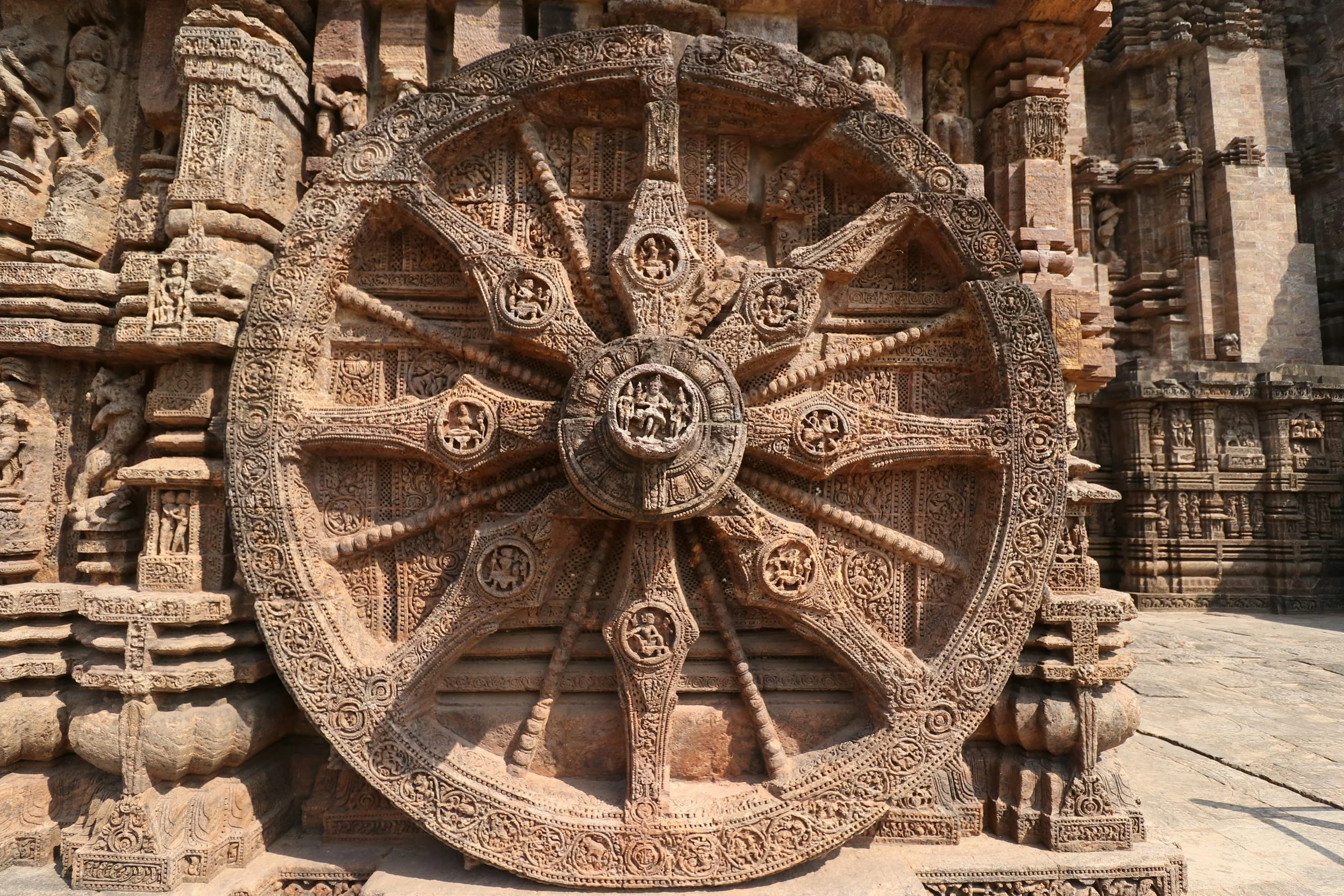
Eight Spokes of a Wheel: Sun Temple, Orissa (India)
The Wheel and Its Eight Spokes
The Eightfold Path is the Buddha's response to the fundamental “Truth” of human life — the truth that human life includes suffering and that there is a way out of suffering. Eightfold path is traditionally pictured as the Dharmachakra, the Wheel of the Dharma, with eight spokes. The spokes are not sequential steps up a ladder. They are integral and interlinked, each one implicated in all the others, turning together.
The eight spokes are placed in three different categories:
Wisdom, cultivated through wholesome practice, ethical conduct (sila), and in my view the study of systems of oppression:
1. Samma ditthi — Wholesome View / Understanding
2. Samma sankappa — Wholesome Thought / Intention / Attitude / Resolve
Ethical Conduct, cultivated through lifelong study of precepts and paramitas:
3. Samma vacha — Wholesome Speech
4. Samma kammanta — Wholesome Activity / Action
5. Samma ajiva — Wholesome Livelihood
Mental Discipline (samadhi), cultivated through traditional Buddhist/Zen training, including koan work:
6. Samma vayama — Wholesome Effort
7. Samma sati — Wholesome Mindfulness
8. Samma samadhi — Wholesome Practice / Concentration
A note on language: Samma in Pali is usually translated as "Right." I prefer wholesome or complete— a word that carries harmonious, unbiased, balanced, genuine, natural, and thorough all at once. "Right" too easily slides into "correct," and correctness is not the spirit of this path.
Four Ways of Seeing the Same Eight Spokes
What makes this teaching useful rather than merely descriptive is holding each spoke through four different lenses at once. None of these lenses is the "real" Buddhism and the others diluted versions. They are four ways the tradition has actually lived and continues to live. Together these four ways of seeing the Eaightfold path can create a completeness that no one way can.
1. Early Buddhist - Theravada perspective: This view distinguishes right from wrong, wholesome from unwholesome, with real clarity — and real tightness, even rigidity. It names the three root poisons (kleshas): moha (delusion, the basic confusion of a separate "I"), raga (greed, attachment), and dvesha (aversion, hate). Moha is the root from which raga and dvesha branch. The implication, taken strictly, is that every time we feel aversion — including righteous aversion to injustice — it is because of attachment. I want to name plainly: this view is not always wise, and it is not always wholesome. It can become a tool for spiritual bypass, a way of pathologizing the appropriate rage of the oppressed.
2. Mahayana perspective: This view is expansive and deeply compassionate, though not trauma-informed in the way we might use that term now — it is "softer" rather than the Early Buddhist view. It says that you can break “rules” when compassionate calls for it. You might have to bear the consequences of breaking “rules” but rigid rules are not everything. Mahayana view has a place for trauma-informed actions. However, superficial compassion can tip into a conflict-avoidance and what is called “negative peace” that can costs lives from a polycrisis perspective.
3. Buddhayana-Emptiness perspective: This view invites us into the complete, whole relationship between Emptiness and Form. Everything simply is complete because it is — full stop. There is no skillful versus unskillful or right versus wrong here at all. No judgment of right or wrong, compassion or lack of compassion at all. Every thought, every intention, carries a fullness and sacredness that can only be tasted in deep samadhi, never arrived at by reasoning about it. This view can be used to harm others.
4. Polycrisis perspective: I have come up with the importance of this “new” polycrisis perspective for a few years now. This view asks us to live in harmony with the natural world and to re-indigenize, in a moment when climate collapse, racism, and speciesism are all raging together, compounding each other. It is the lens most available to ethical study and political analysis — and can be the one usually absent from how the Buddhist path is taught in the West.

Wisdom, Seen Four Ways
For Samma ditthi and Samma sankappa — wholesome view and wholesome intention — the four lenses differ sharply in how they're developed.
The Theravada view can be studied through scripture (sacred texts), through the careful parsing of right and wrong understanding in the Sutras and rules called “Vinaya”. The Buddhayana/emptiness view, by contrast, cannot be reached by study (at all) — it relies on curiosity, patience, and the deep insight that arises only inside sustained meditation practice. No amount of intellectual analysis delivers it.
The polycrisis view sits in an unusual place: it both can and must be developed through study — not of scripture, but of the systems of oppression themselves. In a world where polycrisis is real and accelerating, wholesome thought and resolve require understanding exactly where and how we are entangled in those systems. You cannot think your way to liberation through meditation alone if you don't also know how the supply chain, the land theft, racism, the carbon math actually works. Wisdom, in this lens, includes political and ecological literacy as a spiritual discipline.
Ethical Conduct, Seen Four Ways
The Theravada north star is simple: do not distort the truth. But what is the truth? I could say, "I legally purchased this smartphone," But am I telling the truth? Have I paid its real price — the price of the cobalt miner, the price of the polluted river, the price of the e-waste village downstream? Ethical actions ask us to look past “legal” truth into full truth, and seeing full truth is complex. “Legal” truth is very important and has karmic consequences but it is not complete.
The traditional Buddhist Sutras counsel monks and nuns to avoid conflict and what could be called slanderous speech. Historically, this has too often collapsed into the suppression of truth — into silence around real harm and real scandal inside Dharma communities themselves. Avoiding conflict is not the same as avoiding harm; sometimes it is exactly how harm is protected.
So wholesome speech cannot just mean "not lying." It has to mean moving toward something — generosity, compassion, honoring the body and mind of others. And wholesome action cannot rest on the mere absence of sexual misconduct or lust. That absence is necessary but not sufficient to call something Complete Activity. We are asked to love completely, with a completely open heart — not toward one or two chosen people, but toward each and every thing that arises as our world. This is the love that is present only when there is no barrier, no boundary, no self, and no other.
One Indigenous student in this lineage put “Samma Speech” in this way: speak as if every word is casting a spell. Listen as if gold and precious jewels were dripping from someone's mouth. That is a description of speech and listening as sacred technologies, not as casual exchange.
From the emptiness view, when we recognize our lives as the expression of this very moment, we touch a deeper, more pervasive discipline — one that doesn't have to be imposed because it is already the nature of things. It is as natural as a wall holding up a ceiling, as a bird's song sounding like a bird, as the inhale giving rise to the exhale. Wholesome Action, at this depth, includes the ordinary textures of a life — eating well, not numbing through alcohol or intoxicants, not stealing, not causing harm through unwholesome sex — but it is held inside this larger, undivided love rather than reduced to a checklist of restraints.
We can work on our individual speech and individual actions in relative privacy. Livelihood is different — it is the spoke where we meet the systems directly, where personal ethics runs straight into political economy. And no one can do this work alone. Livelihood cannot be decided just by an individual choosing better; it requires the support of a community choosing differently together. Livelihood is where the rubber meets the road. This is why the indigenization of economies — rebuilding economic life around reciprocity, land relationship, and collective sufficiency rather than extraction — is not a nice add-on to the Path. It is the precondition for living in true harmony with the natural world.
Mental Discipline, Seen Four ways
The last three spokes — Wholesome Effort, Wholesome Mindfulness, and Wholesome Concentration — are traditionally cultivated through sustained Zen training, including koan work. These are the spokes most associated with "meditation" in the narrow, modern sense. But seen through the Wheel as a whole, they are inseparable from everything above them: the quality of our concentration on the cushion cannot be cleanly separated from the quality of our speech, our livelihood, our view of the systems we're embedded in. Effort bridges the ethical and the contemplative — it is the energy that keeps both alive, day after day, bump after bump.
Turning the Wheel Together
What we can keep returning to is that the Eightfold Path was never a private path. It was, from the very beginning, a collective or communal path — people living simply, together, in a particular place, depending on each other and on the land that fed them. The polycrisis we are living through now is, in part, the long consequence of forgetting that. Reindigenizing our economies, our speech, our listening, our sense of what counts as the truth — this is not a departure from the Dharma. It is a return to the conditions under which the Wheel was first set turning.
We will not arrive at enlightenment and stay there. We will bump into it, lose it, and have to arrange our lives — our view, our speech, our livelihood, our attention — so that we bump into it again. The Eightfold Path, held through all four lenses at once, is simply a very old, very thorough description of how to keep arranging.